YOU CAN FINALLY SPEND YOUR STABLECOINS LIKE MONEY
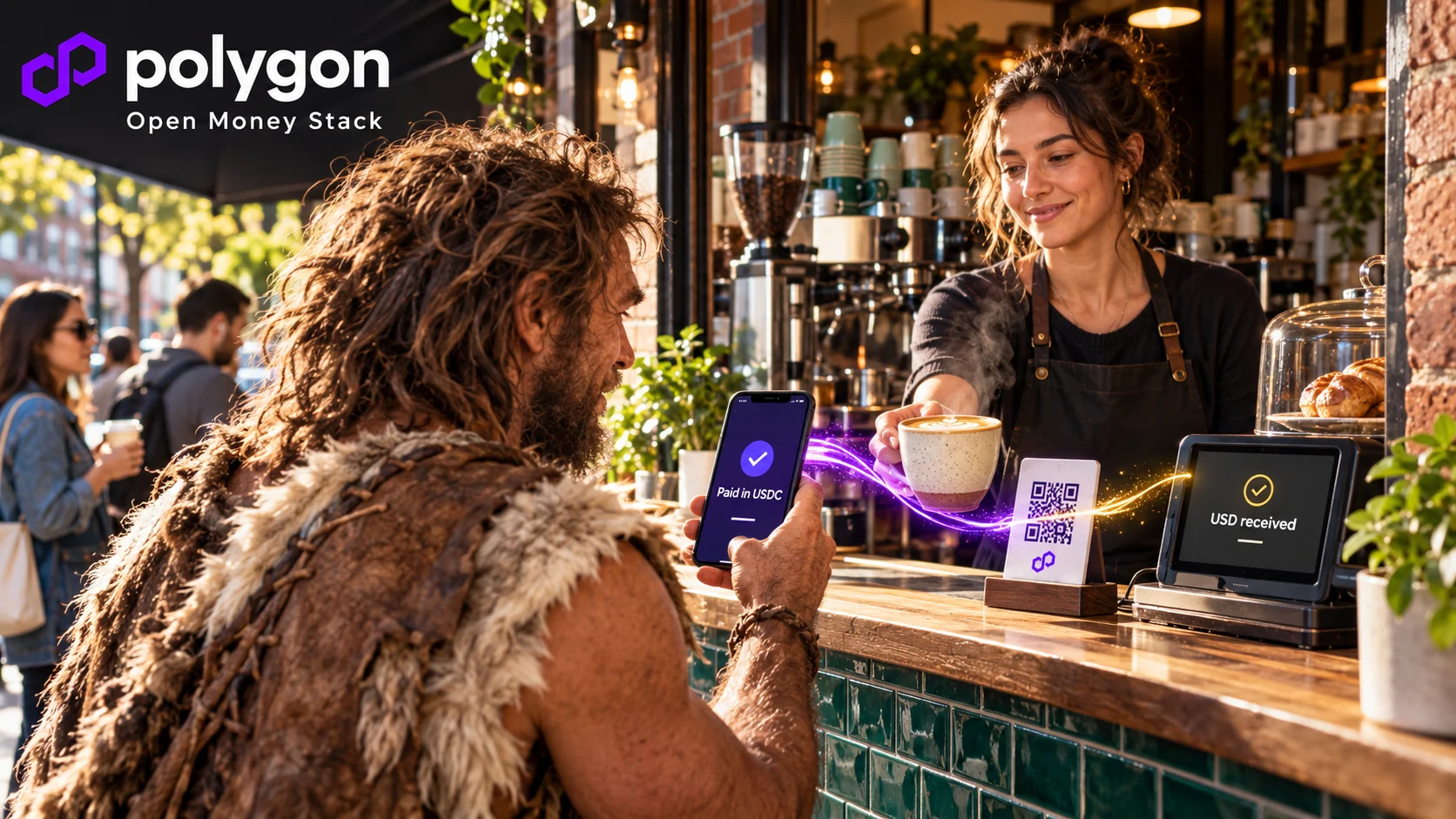
As I said in the first and second article in this series, I’m just a caveman in 2026. I need stuff simplified when being explained to me. All I know is that I smell something delicious in the air. It’s coming from a cafe across the street. I make my way through the front door, want a cup of that delicious coffee I smell, pull my cell phone from my fur pocket, but now what?
I’ve got digital dollars sitting in a wallet, stablecoins on Polygon. They’re worth a dollar each, as real as whatever’s in my checking account. I can finally spend stablecoins like money, so I scan my QR code at the register and buy that cup of Joe. One happy caveman.
For years you couldn’t spend stablecoins that way, not without middlemen routing the transaction and likely taking a cut from the merchant. Think, credit cards, Zelle, and Venmo.
As of this fall though, a store can take your stablecoin at the register, and you can send one straight into your own bank account without handing it to a platform on the way. October 2026 marks a piece of blockchain history. Polygon finished acquiring a licensed American payments company to run the pipes.
The money you can’t spend
Everybody who’s traveled has a version of this. Foreign bills in a drawer somewhere. Real money, worth something, but useless at the coffee shop on your corner. Changing it costs you a bank trip, the spread, and a wait, and by then you’ve spent more effort than the money was worth.
That’s been stablecoins. More than $3 trillion has moved across Polygon’s rails since 2020. People in Argentina and Turkey hold them because their own currency keeps losing to the dollar. Companies use them to pay contractors in places where a wire takes a week.
And then you want a bagel sandwich.
My dad told me in 2017 that this would never happen. I’d just sold my ConocoPhillips stock to buy Bitcoin, and he figured his son had been taken. Last year, at 83, he told me crypto might be here to stay. Now I want to hand him a coffee I paid for out of my mobile wallet just to see his face. He rarely admits when he’s wrong or says sorry, but that’s a conversation for my therapist, LOL.
Why cashing out a stablecoin used to be so hard
The old path went like this… You send your coins to an exchange. The exchange holds them (remember FTX?). You sell and convert to USD or whatever your local currency is. Then you withdraw to your bank and you wait up to 3 business days. Then you wait again for the deposit to clear at the bank.
Count the waits. Now count who’s holding your money during them.
In September, Stable.com added Polygon support and cut the middle out. We’ve been running a Stable testnet validator since that project launched. It’s Unlimit’s financial platform, and if you hold USDT or PayPal’s PYUSD, you can fund a bank transfer straight from that wallet. The money lands in an account in your name, across more than 180 countries and 150 currencies, and it never sits in anybody else’s hands along the way.
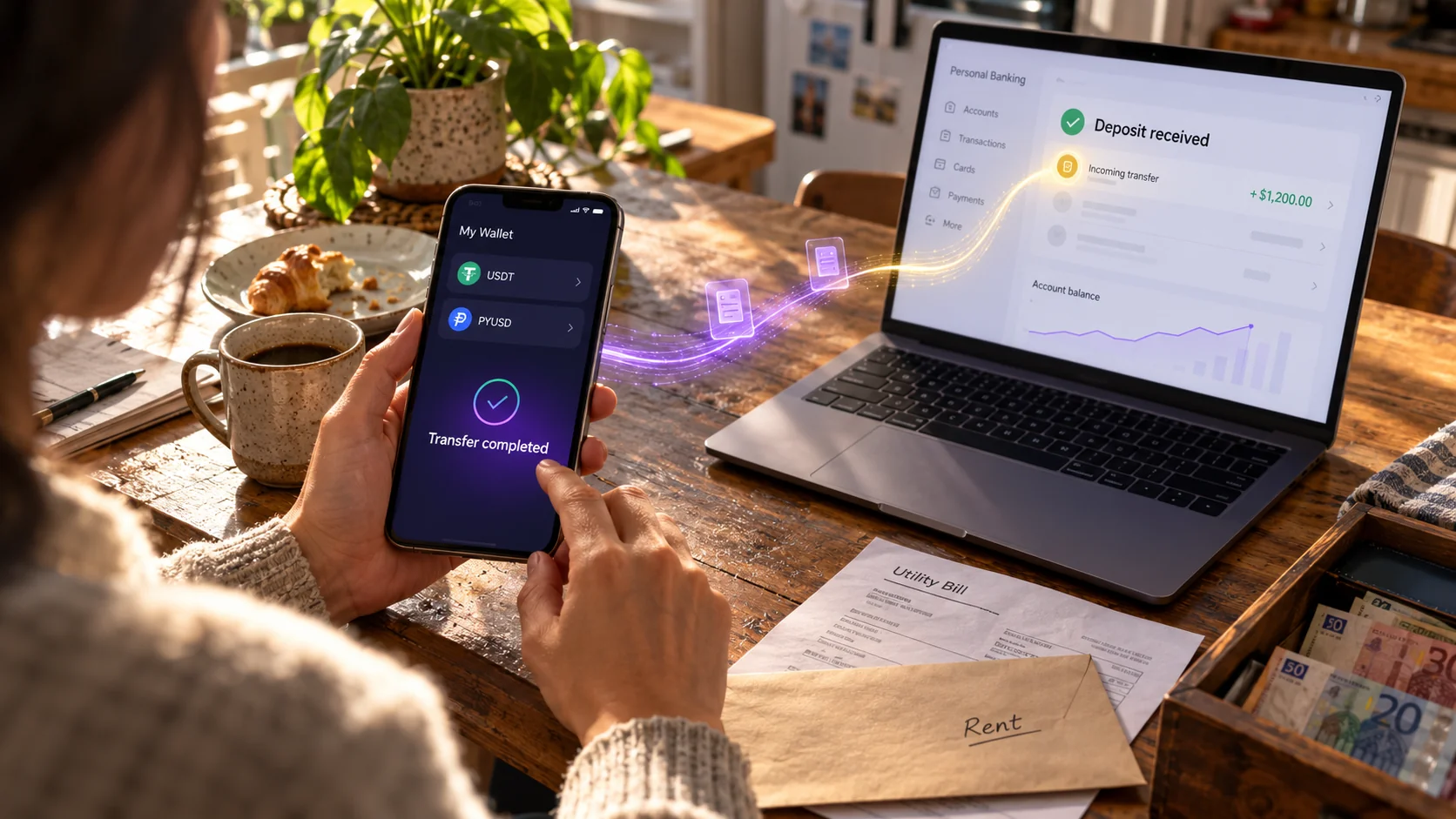
Marc Boiron, who runs Polygon Labs, said it about as plainly as it can be said. “People should not have to surrender control of their assets simply because they want to send money to a bank account.”
How a store takes a stablecoin at checkout
Now let’s look in the other direction, the person standing at the register taking it from you.
At the end of September, Polygon launched Checkout inside the Open Money Stack. A merchant drops it into the payment flow they already run. You pay from whatever wallet and whatever balance you like. Polygon handles the route, and the merchant gets paid in the currency they actually want at the moment of the sale.

That last part carries more weight than it sounds like. The reason your coffee shop has never taken crypto isn’t ideology. The owner has rent in dollars, payroll in dollars, and a bean supplier who’s never heard of a wallet. A payment method that hands them something they then have to go sell is a nonstarter. Getting paid in dollars while you pay in stablecoins is the whole trick.
Every one of those sales settles on the network our validator helps secure, so if you want a piece of it you can stake your POL with Atlas.
Why Polygon bought a licensed payments company
Back in article one I mentioned Polygon had agreed to acquire Coinme. On October 14 that deal closed.
Here’s what came with it. Polygon’s US payments business now has coverage across 48 states, through 37 state money transmitter licenses and 11 exemptions, and it’s registered with FinCEN as a money services business.
I said in article one that collecting those licenses takes years of lawyers and red tape. Buying the company that already has them is the quicker, smarter move.
Four businesses were named as the first to move money on the combined stack, and one of them makes it concrete. Toku runs payroll in stablecoins and plugs into ADP, Workday, and Gusto the way any payroll provider would, moving more than a billion dollars a year and handling tax withholding in over a hundred countries. Those are salaries. Actual people getting paid rent money on rails almost none of them will ever think about. Tazapay, Mesh, and Kira are the other three.
This is what separates Polygon’s announcement from the competition. A chain can be fast and cheap and still leave you stranded at the last step, because the last step was never a technology problem. It’s a licensing problem, and Polygon solved it by acquisition.
The same rule, pointed at payroll and at robots
Three more from this month, and the first two are the same idea wearing different hats.
On October 12, Polygon added automated payout runs. It works like autopay. A company says once who gets paid, how much, and when. After that, the payments go out on their own and the wallet checks every one against those rules. Nobody signs four hundred transactions by hand.
Two weeks later, the same idea aimed at software. Agent spend controls went live on October 26. You hand an AI agent something like a company card. Good for this job, up to this amount, until this date. The wallet enforces that limit onchain. Your software can go buy things. It can’t go buy whatever it feels like.

If that sounds familiar, it should. It’s the move T-REX Ledger makes with ownership, from last article. Put the rule inside the thing itself and nobody has to be trusted to follow it.
And Polygon OMS added Solana. This is a big deal because Solana is a brand institutions know. A business building there can take a customer from a bank deposit to a stablecoin balance to a bank payout without that customer ever learning the word bridge. TRON got the same treatment a few weeks before that.
So can you actually spend stablecoins on coffee?
Sort of, and more of it every month. If your coffee shop’s payment provider has added Checkout, then yes, straight from your wallet. If it hasn’t, move the money to your bank in minutes and tap your card like always. Both roads are open, and neither asks you to hand your money to a stranger in the middle.
Even this caveman can order a latte.
What this means if you stake POL
If you stake POL with Atlas, all of this settles on the chain your validator helps secure. Checkout purchases, payout runs, bank transfers through Stable.com, and the volume arriving from TRON and Solana. Atlas has run Polygon validators since the network’s genesis, and we’ve been running infrastructure since 2019. More payments crossing the rails means more reason for the rails to matter.
Next time we’re going after a job title almost nobody outside of finance has said out loud. The transfer agent. I promised you that one in article two, and it’s the most interesting boring job in the world.
Coffee’s on me. I can finally pay for it.
Spending stablecoins, questions answered
Can I spend stablecoins at a regular store today?
Sometimes. If the merchant’s payment provider has added Checkout through Polygon OMS, you pay from your wallet and they get paid in their own currency. If not, move the money to your bank first.
How do I get stablecoins into my bank account?
Through Stable.com you can fund a bank transfer directly from your own wallet if you hold USDT or PYUSD, with nobody holding your money along the way.
Do I need to do anything if I hold POL?
No. The payment volume lands on the network your stake already secures.
What is the Polygon Open Money Stack?
It’s Polygon’s payments layer, the set of parts that move money between wallets, stores, and banks. Checkout sits inside it for merchants, and it now reaches across Solana and TRON as well as Polygon.
Why did Polygon buy Coinme?
For the licenses rather than the technology. The deal closed on October 14 and gave Polygon’s US payments business coverage across 48 states, through 37 state money transmitter licenses and 11 exemptions, plus FinCEN registration as a money services business. Collecting those from scratch takes years.
Can a company pay salaries in stablecoins?
Yes. Toku, one of the four businesses named on the combined stack, runs payroll in stablecoins and plugs into ADP, Workday, and Gusto. It moves more than a billion dollars a year that way and handles tax withholding in over a hundred countries.



Nothing we say is financial advice or a recommendation to buy or sell anything. Cryptocurrency is a highly speculative asset class. Staking crypto tokens carries additional risks, including but not limited to smart-contract exploitation, poor validator performance or slashing, token price volatility, loss or theft, lockup periods, and illiquidity. Past performance is not indicative of future results. Never invest more than you can afford to lose. Additionally, the information contained in our articles, social media posts, emails, and on our website is not intended as, and shall not be understood or construed as financial advice. We are not attorneys, accountants, or financial advisors, nor are we holding ourselves out to be. The information contained in our articles, social media posts, emails, and on our website is not a substitute for financial advice from a professional who is aware of the facts and circumstances of your individual situation. We have done our best to ensure that the information provided in our articles, social media posts, emails, and the resources on our website are accurate and provide valuable information. Regardless of anything to the contrary, nothing available in our articles, social media posts, website, or emails should be understood as a recommendation to buy or sell anything and make any investment or financial decisions without consulting with a financial professional to address your particular situation. Atlas Staking expressly recommends that you seek advice from a professional. Neither Atlas Staking nor any of its employees or owners shall be held liable or responsible for any errors or omissions in our articles, in our social media posts, in our emails, or on our website, or for any damage or financial losses you may suffer. The decisions you make belong to you and you only, so always Do Your Own Research.